
MY AI-INDUCED STROKE
How a Podcast for Children Tangled My Brain and Restored My Hope

I am stuck in a crawl of traffic on the 10 West near Barrington, a familiar refrain. I am hungover, badly so, also a familiar refrain - increasingly less familiar since having a second child - but nonetheless, familiar. The blazing midday March heat, strange to many, is also familiar. In my aural periphery, beneath the hum of engines and my static of thoughts, is the also familiar banter of Mira and Finn - co-hosts of a podcast called “History’s Not Boring.” This is for-kids-by-kids content, in which these precocious and infinitely curious UK siblings walk fellow kiddos through all manner of historical stuff: What was Pompeii? Who was Mahatma Gandhi? How did they build the Pyramids of Giza and – this week, for some reason – Who Created the Legend of Zelda?
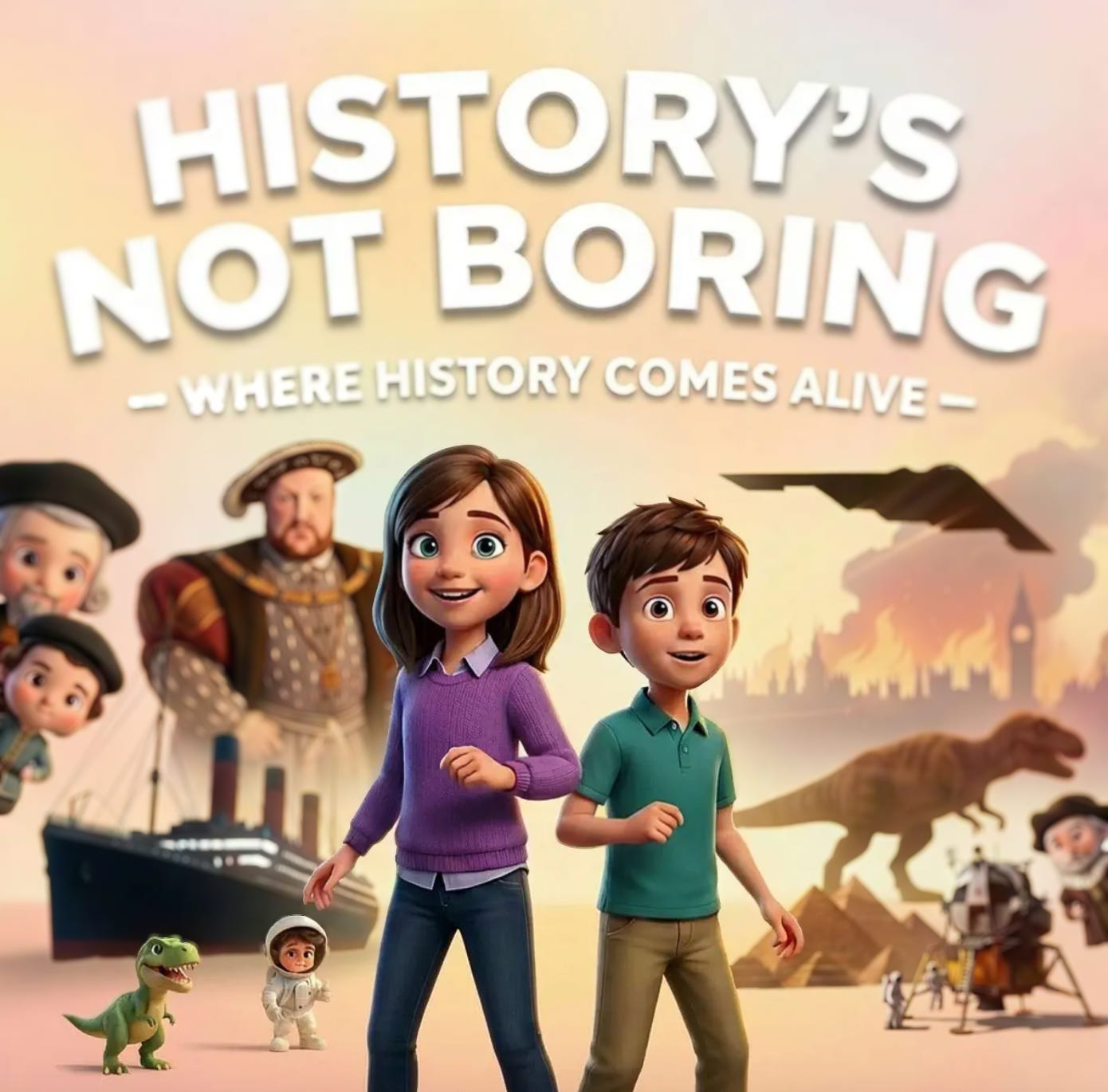
In the backseat on this day, the target demo, my 5yr old son, chomps on Cheddar Bunnies and listens intently. “History’s Not Boring” has, for months now, been his meditation for our daily, congested commutes to wherever we’re going (today, the beach). Mira and Finn’s patter – while mildly-to-considerably irritating – temporarily tames my hyperkinetic savage of a kid, certainly more so than dad’s groan-inducing front-seat TED Talks on Aphex Twin or Ahmad Jamal or the cultural significance of Tampa Death Metal (that said, as an avowed asshole, I am compelled to note with pride that he can identify Elis Regina by voice and often requests The Avalanches for our nightly dance parties).
ANYWAY, here we are: Dad sweating out last night’s bourbon, son’s face pressed to the side panels of his booster seat, podcast-for-kids playing. I do on occasion pay attention to Mira & Finn, when they dive into the particulars of things about which I give a shit and retain marvel for – Stonehenge or the Moon landing - but the origin story of Zelda? Eat a dick. I’ve got grown-up things to process. So, as we continue our sluggish westward migration, that is what I do. I process. To do lists, forthcoming events, financial concerns, recent mistakes I’ve made – the evening prior for example.
The rumble of my ancient truck.
The mechanized hum of traffic.
The whirr of an A/C system pushed to the limit.
Mira and Finn, low in my internal mix, prattling on.
But then, gradually, I become aware that something is… off. Something sounds… wrong. I call my senses to attention, sweep all thoughts from the table, and focus. It’s Mira and Finn. What are they talking about? Their tone and cadence are, as always, jolly and inquisitive, but their actual words, the words they are saying on the podcast sound… strange. I check the rearview and find my son fixed in position, mouthful of snack food, listening. I turn up the volume and again it SOUNDS right but… it’s not.
Seriously, what the fuck are they talking about? There are words I recognize but others are… not words. They’re almost words. They sound like words. But… they’re not. The pace and timbre of their conversation is natural and rhythmic, but they are saying… nothing. It’s a stream of garbled gibberish, my mother tongue spun in the blender, eerily rendered in the squeaky voices of British children.
And it’s in the moment I become convinced that I am having some kind of ominous synapse misfire, that some manner of brain glitch has tangled the neural pathways which govern the processing and recognition of spoken language. This is first sign. This is how it happens.
I am having a stroke.
I nudge the truck between begrudged commuters and find my way to the shoulder of the 10 West where I stop, kill the engine and – in this relative quiet – listen to Mira and Finn with laser focus… and again, hear only a syllabic salad. I am dripping sweat. My heart beats like a caffeinated hummingbird. What is about to happen to me? What is stage 2 of a stroke? Should I put my wallet in my mouth? No wait, that’s for seizures. Should I dial 9-1 –
“Dada what’s going on?”
My son has only now processed that, for the first time in his life, he is on the shoulder of a freeway. And, as with all kids and their annoying evolved propensity to “sense” when something is amiss, he senses something is amiss.
“One second kid.”
At this point, the lone voice I hear on the podcast is that of Finn’s. He’s carrying on, atypically, with no interjections from Mira. As the stroke intensifies, I hear him, with his signature, irrepressible enthusiasm, not only speaking but now REPEATING unqualified nonsensical phrases.
I turn and look at my son.
“Kid, do you understand what they are saying on this show?”
My son shrugs, puzzled by this whole affair, oblivious to my medical emergency. His face is pancaked in Cheddar Bunny dust and I briefly pause from my fatal stroke-in-progress to note that I’ll need to wipe him down with his kid brother’s diaper wipes which I hope are in the center console.
I pause the podcast.
“Dada, put it back on!”
“Hold on one second.”
Nervously, I hunt down some talk radio and, for a full minute, listen to every word and monitor my processing. It sounds… normal. They are speaking in English, in actual words. I put on a song and listen. I understand the lyrics.
I put the podcast back on… and the gibberish resumes.
The sweating stops. My heart rate slows. I draw in a deep breath.
I am not having a stroke. I don’t need a wallet in my mouth. Mira and Finn are actually, for reals, saying… nothing. Because Mira and Finn do not exist.
This is what I heard:
I am not without savvy. I spent many years creating and writing TV and – later – working a bit in podcasts. I know how the sausage is made. And I did have my doubts about Mira and Finn being actual living human children. There was something too clean and precise about their dialogue, which, even if hard-scripted, would have been hard to deliver with such perfect timing. My best guess was they were probably older voice actors, run through some pitch filter and heavily edited in post. It had crossed my mind that they were AI but conceptually, that prospect seemed too… nefarious. Chalk this up to idealism but, seeing how my son responded to them, how he viewed them as these somehow worldly peers, I committed to believing in their physical existence. He’s had enough education at this point to recognize the imbalance of power in a classroom. “Dada, it’s not fair that the teacher gets to decide how we learn.” But Mira and Finn were not teachers. They never scolded him. They spoke to him as an equal. I wanted them to be real.
But even considering they MIGHT be AI, there is something distinctly disorienting that happens when the robots blunder. These are not 1960s vacuum cleaners, they are the product of the brightest minds in tech. Trillions of bitcoins or whatever were mined for their dependable blandness. They’re not supposed to do this.
And what exactly did they do? What happened to the Mira and Finn bots? Seeking answers, I rang up a number of elite machine learning engineers at several prominent AI firms in Silicon Valley. When none of them called me back, I just asked an AI (Perplexity in this case). Having described the event, I was given this as a probable cause:
AI text generator failure: If the “kids” are actually text‑to‑speech voices driven by a script (or heavily edited real kids), a language model can sometimes output long stretches of internally consistent but semantically empty word salad. It keeps the rhythm, intonation, and conversational back‑and‑forth, but the words stop meaning anything because the model has fallen into a loop of high‑probability syllables rather than meaningful sentences.
A “loop of high-probability syllables” occurs when the model repeatedly selects locally likely tokens (common syllables like “th,” “ing,” or “bla”) that fit patterns from its training but fail to form coherent meaning. This creates fluent-sounding gibberish because the model optimizes for immediate probability over long-term sense, often entering a repetitive cycle where outputs reinforce themselves without progressing.
In response, I asked a judgmental follow-up question, “Is this essentially a long-winded way of saying ‘It was AI slop?’” Perplexity was candid but uncommonly blunt in a way that suggested at least some offense was taken…
Yes, it’s essentially a long-winded way of saying “It was AI slop.”
I am not “fired up” about AI one way or the other. I view it through a distinctly practical and perhaps Pollyanna lens: It is a thing we have created that will impact our lives for better and worse but its absence of an emotional core and lived experience will relegate it to certain duties. Humankind will prevail. In fact, perhaps as a coping device - or form of denial – I have chosen to frame AI as a kind of “genre” and imagine a time when we’ll sift through film or music or podcast options and see it listed alongside Drama or Dungeon Synth or Kids & Family as simply that, a genre. An option. But here, on this day, in my car, suffering an AI-induced psychosomatic stroke, I felt the wicked tentacles of AI tightening around my chest, like climbing vines choking an old home with frightening speed.
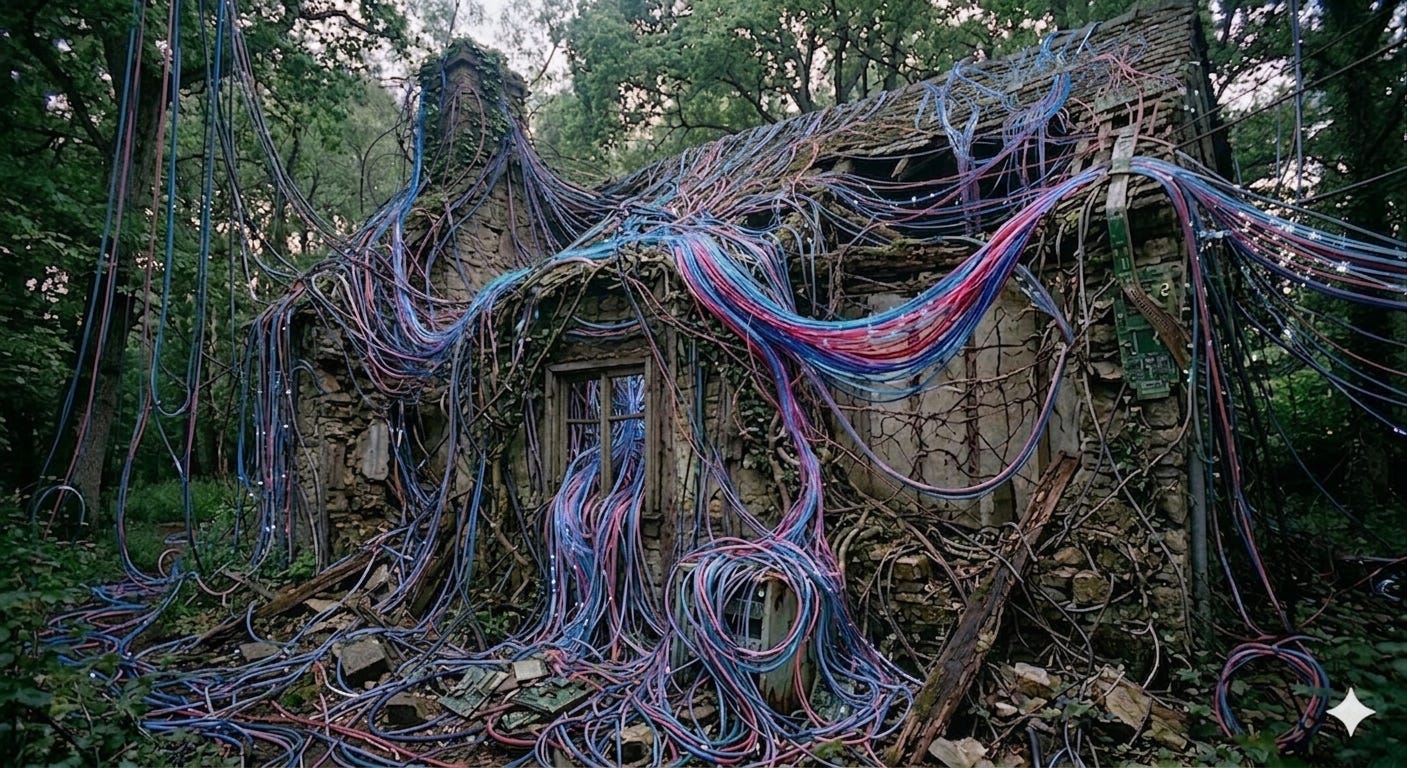
And perhaps in some way, at this moment in time, many of us feel this way – like crumbling cottages powerless against the advancing weeds of invincible tech. But to this I say two things:
1. 45 minutes after my quasi-stroke on the 10 West, I sat on the beach watching my son repeatedly and blissfully heave a large plastic garbage truck into the surf, certain in that moment that – if pointed towards real, tangible joys – he will live his life unbothered by AI slop. It will be there, tenfold what it is now, but he will rise above. He’s already rising.
2. Fuck you Mira and Finn.
fin.
“But the link they come him to bring in part on the jumply laugh” = what’s the problem?
I listened to this clip and frankly, I like it.